A limerick a week #62

#iseesnakes – not a fallacy!

In Greek mythology, the gorgans are hideous looking women whose features include a coiffure that comprises living snakes instead of hair, and whose visage will turn you to stone if gazed upon; you get petrified – literally.

While the three best-known of the gorgons were the sisters, Stheno, Euryale and Medusa, the latter was the most notable of all. Legend has it that she was slain by Perseus who avoided petrification by looking upon her indirectly through her reflection in his shield.

I first came across their mythology as a kid watching a Hammer House of Horror film, The Gorgon, in which Megaera, the last of her line, was responsible for some mysterious deaths in a remote German village.

Just another bad hair day.

This all came back to me a few months ago when a colleague posted an article on Yammer by the Classics professor, Mary Beard. It was a thought-provoking article, based on earlier lectures in which she traced the history of the lack of a public voice for women back to the classical civilisations. It also provided a horrifying picture of the internet abuse that she has received as a woman speaking publicly in the modern-day.

Her lectures, which have now transformed into a short book, Women and Power: a Manifesto by Mary Beard, in part discusses the evil image of a harridan that was fomented by the gorgon myth, and how that translates directly today into the visual and verbal abuse directed at Hillary Clinton by, you’ve guessed it, Donald Trump.

Nevertheless, I do take issue with Professor Beard’s comment on the symbolism inherent in the gorgons’ snakes-as-hair imagery. She wrote:

It doesn’t need Freud to see those snaky locks as an implied claim to phallic power.

A nest of vipers, not a dickhead!

I think that is nonsense. I see snakes! When I pointed this out to my colleague, her reply was along the lines of “I’d love to see you argue that with Mary Beard!“. But actually, I would.

When I saw Megaera in my youth, I saw snakes, not a willy-derived metaphor, and I still see snakes. My view is that you do have to be a Freudian to interpret the gorgons’ serpentine barnet as symbolic of phallic power; as I wrote in The Tall Child’s autograph book when he was wee: “It’s not what you look at that makes you different, it’s what you see” and I strongly suspect that most people see snakes – I can’t be that different from other folk!

I’m not qualified to critique Professor Beard’s interpretation of any of the other classical symbolism in the silencing of women. It seems mainly to relate to Greek Gods and Goddesses and there is some criticism of it in a second Graun review, but that does not detract from its powerful central message in either my mind or that of the Graun’s reviewers. It remains a good read that is both interesting and educational.

… and, just to raise the tone a bit, it also inspired this week’s limerick:

There once was a Classics professor
Whose lecture notes claimed to address a
Freudian thought
Of the Serpentine sort
‘Bout a dickhead with a dodgy hairdresser

‘Twas the yeast I could do …

… and some other things you knead to know:

A successful day at the Bread Ahead bakery school in Borough Market on the full-day French baking course (boulangerie, non pâtisserie).

The tutor remembered me from my last visit 20 months ago, possibly due to the living and breathing realisation of a ”northern meme” that clearly amused a bunch of Chelsea Girls on that course.

Sadly, no Chelsea Girls to entertain this time. Maybe they go to the new Bread Ahead bakery school in, er, Chelsea. Still, it was fun this time too.

Les Croissants. A lot of time spent learning the correct lamination process. Time well spent!


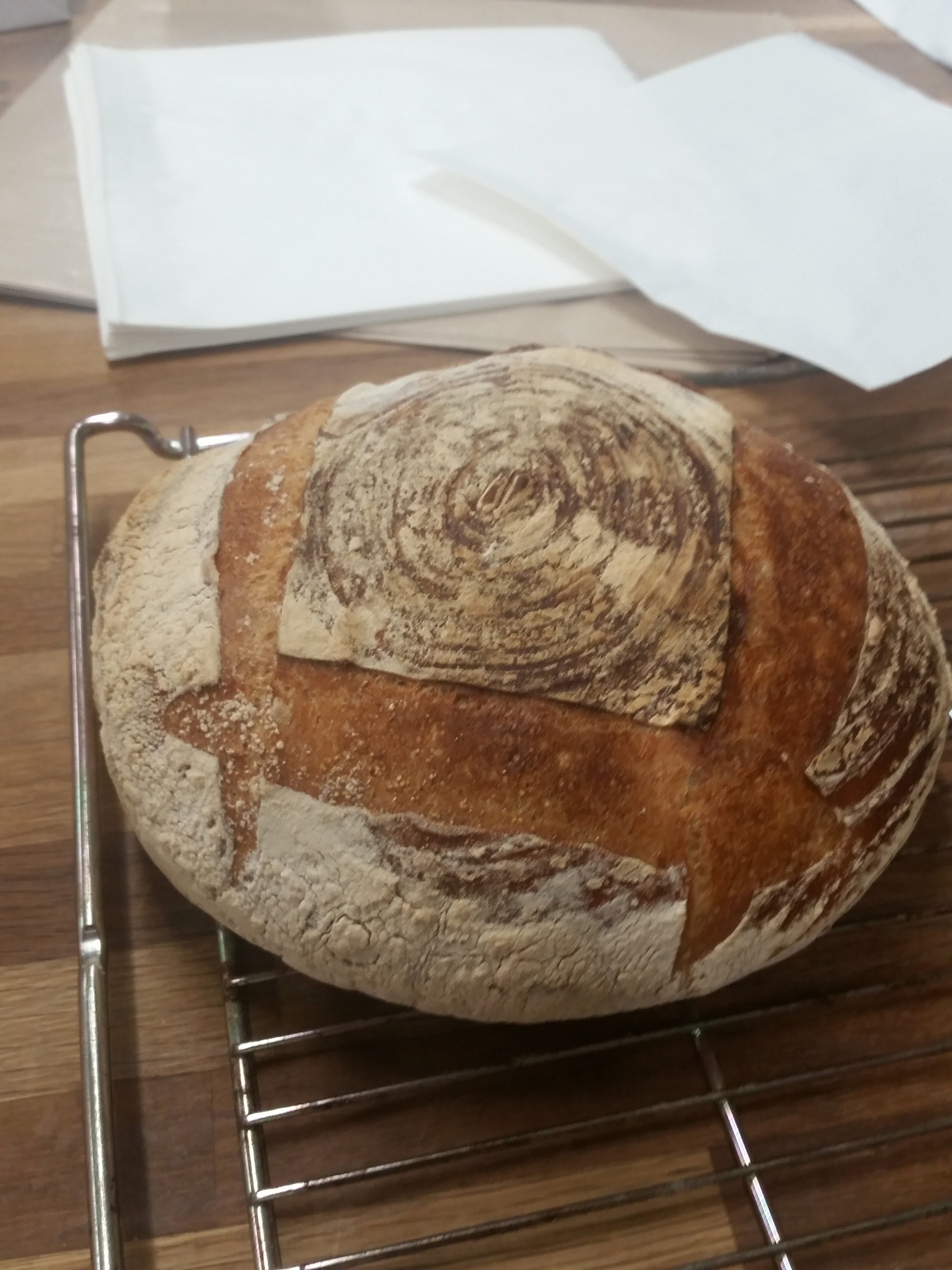
My Pain de Compagne. Baked in a Dutch Oven, aka a Le Creuset steel casserole.


… and my piéce de resistance, a plaited brioche that was singled out for praise. Merveilleux!

Unfortunately, the Madelaines that comprised our fourth bake of the day didn’t survive long enough to be photographed  – ils ont disparu; simplement trop dèlicieux.

Fin!

A limerick a week #61

In at the deep end  …

Years ago, a friend mentioned that he’d told his wife about an uplifting insight he’d had about some issue or other, to which she replied (in a broad northern accent with vowels wide open) “Oh, John, don’t be so deep!”.

I thought about that when my inamorata told me she didn’t follow the links in my blog because I went into things too deeply. (Meantime, my dear old mum lost interest in it because I used too many long words!).

So I was amused to see this cartoon from an Aberdeenshire-born artist, which seems to sum up my domestic readership:

… and the same domestic readership inspired this week’s limerick:

Your essays can put me to sleep,
Hence a rule to which you should keep.
‘Cos it’s really a slog
To plough through your blog.
So from now on just don’t be so deep!

Postscript: I’m not deep, I just sank to the bottom (plus I have internet access)😎

The eleventh of the eleventh plus one

The time of his life (addendum)

Following on from the previous post, I was intrigued by HWS’ Soldier’s Pay Book for use on Active Service. The details of his daily pay on commencement of active service are illustrated below:

The pay book also includes a couple of pages that allowed the soldier to record a short form of will, presumably for individuals that had not drawn up a traditional last will and testament. HWS had completed the relevant page, but in writing that was so small that it was difficult to decipher (hence the delay in posting it here).

In fact, HWS had not written a will in his pay book. The text he had included comprised a poem: The Steel of the D.L.I   A Tale of the White Gurkhas (author unknown to me) that had appeared in the Westminster Gazette in tribute to another of the DLI Battalions, the 2nd. Here it is in HWS’ hand writing:

A record of the poem can be found online in the Durham County Record Office:

(This image comprises one from a slide show Life and Death as a Soldier in the First World War (slide 22 of 27) produced by the Durham Records Office.)

HWS was not a warmonger, in fact I knew him as a peaceable, good-humoured gentleman who, like many, simply served his country in two world wars. I suspect he copied the poem into his pay book not in any glorification of the victory at Hooge, but to pay tribute to the courage of his colleagues in the DLI (and their fallen) in battles throughout the war.

I have transcribed the slide show image below (anyone paying close attention will see that HWS chose the spelling ‘enquire’ over the archived document’s spelling of ‘inquire’ – that’s my kind of pedantry – and, as in the Records Office version, the last verse appears to be the intentional concatenation of what otherwise appears to be two verses).

How the D.L.I. Fight
Magnificent Endurance and Spirit at Hooge

A tribute to the fighting qualities of the 2nd Battalion Durham Light Infantry is paid by a poem published in last night’s Westminster Gazette under the title “The Steel of the D.L.I.: A Tale of the White Gurkhas”. The following summary of the exploit prefaces the verses, which we take the liberty of reproducing. The 2nd Battalion Durham L.I. are known at the front as the White Gurkhas. At Hooge in the early part of August, as part of the Sixth Division, the D.L.I. had to attack a part of the German trenches. At dawn they lay in front of our trenches when the artillery lifted on to the German third line. One of our mines was exploded. The D.L.I.s were in and at them. Some sixty men held the crater for three days. They went in to section as a battalion and came out under 200 strong when relieved. When they marched out their bugle band met them in the communications trench and played them out under shell fire. As they went to the huts at Poperinge the troops lined the road and cheered them.

The Steel of the D.L.I.     A Tale of the White Gurkhas

Just ask them down at Armentieres,
At Arras, at Neuve Chapelle,
Inquire of the Germans at Ypres and Hooge
Inquire down below in Hell,
And ask where the shrapnel bursts and screams
And the whiz-bangs crack and fly –
You’ll find the Germans don’t forget
The steel of the D.L.I.;
Yes, especially well you’ll find in hell,
They remember the D.L.I.

But Hooge was the show where we got to grips,
And they didn’t have all the laugh,
We taught them some tricks in bayonet play,
And we showed them that two can strafe;
And we went all out and we went right thro;
And we hustled some off the map,
And we got us back just a bit cut-up
From out of that blood-red scrap,
Yet we mustered then barely seven-score men
At the end of that bloody scrap.

The night that followed we got relieved,
God knows we had earned a spell;
But we swore to show them just what we thought
Of their perishing shot and shell.
So we marched right out from before their lines,
What was left of us, grimed and sore,
And we swung away with our bugle band,
Playing us out before
Let them blaze and slam, not a farthing damn
Cared we more than we cared before.

We marched right out for them all to see,
To strafe if they thought they could;
To show them they never could get us beat,
That we’d come again strong and good,
And the band in front played us right away,
Like a pukka band we went.
And we marched away to the huts and sleep,
The sleep of the well-nigh spent.
So ask them down at Armentieres,
At Arras and Neuve Chapelle,
Inquire of those left of the men we met,
At Hooge, where we gave them hell,
Inquire of the dead that our bayonets left
To rot neath the August sky;
You’ll find that the foe has not forgot,
The steel of the D.L.I.,
And especially well you’ll find in hell,
They remember the D.L.I.

Postscript: More can be read about HWS’ battalion on the Durham at War website.

The eleventh of the eleventh


The time of his life …

The watch:

The “Erimus”. An open-face, top-wind pocket watch sold by Collingwood & Son Ltd of Hartlepool.

The movement:

An unsigned Swiss-made 17 jewel movement

The case:

Dennison Watch Case Company ‘Star’ model. Nine carat rolled gold on brass (guaranteed durable for 10 years).

The history:

The owner’s self-inscribed details: HWS Aug 30 1914 7 DLI

This antique pocket watch is worth about £30. It is at least 103 years old as that is when my great uncle inscribed it.

Here’s part of his story:

Harold Whidby Speight (b. 30 Aug 1893) seems to have inscribed the watch on his 21st birthday in August 1914 – perhaps it was his parents’ gift to him.

Having signed-up with the army reserve 22 months earlier, August 1914 comprised the month not only of his 21st birthday, but also that of his mobilisation with D company of the 7th Durham Light Infantry. In April 1915, he embarked for Belgium as a sergeant with the 50th Northumbrian Division, arriving just in time for the second battle of Ypres (with neither gas mask nor steel helmet). He earned three shillings (15 pence) a day of which two shillings was remitted to his parents in Sunderland, leaving him with one shilling a day for any local expenses at the front.

On 30 September 1915 he was sent to recce the enemy positions along with another sergeant.  On reaching the German wire they made their observations and dropped off some copies of ‘John Bull’ before returning to their own front line. (‘John Bull’ was a popular English magazine of the time with its circulation in 1914 estimated to have been in excess of 750,000.)

Later, when looking over a parapet to show an officer where they had been, he was shot by a sniper. The bullet entered his right cheek and exited behind his left ear. After being hospitalised in France and England he joined the reserve battalion until being demobbed in early 1919.

(The wound left him half deaf with a slightly palsied face and permanently weeping eye.)

Twenty-five years later, in March 1944 the Royal Navy called for volunteers to man small craft in support of the D-Day invasion and so, in July 1944, he found himself serving in the Second World War, this time as a deck hand on an armed diesel trawler carrying shells and depth charges to the fleet as they returned from Normandy for more ammunition.

In civvy street, having joined the Sunderland office of the Institute of Weights and Measures in 1909, he qualified as an inspector in 1919 after demobilisation from the army and joined the Newcastle office, becoming chief inspector in 1936. He retired in 1953 as a Fellow of the Institute having also been its Chair for two years during the Second World War.

Thereafter he moved to Kendal where he volunteered for the local Red Cross in 1954, helping out into the 1970s. He also painted in watercolour, wrote poems, corresponded worldwide with other Esperanto enthusiasts, and cycled everywhere on an original Moulton F-frame bike. He even spent two months on holiday in Australia in 1977 at the grand old age of 84 (but without his bike).

While still getting over his injuries and the trauma he experienced during the First World War, he took a long sea voyage, working his passage to and from South America. During that trip he visited Peru and the hot and steamy port of Guayaquil in neighbouring Ecuador which, many years later, I visited a number of times in a professional capacity. I wonder what he thought of it – I hated the place – but compared to the trenches it must have felt like an oasis of calm to him!

HWS in 1961 – a dapper chap!


A limerick a week #60

Ordure, Ordure!

If you are old enough, you will remember The Two Ronnies TV show when the titular duo were at the peak of their fame. You might even remember the mini-serial that threaded through their shows in 1976: The Phantom Raspberry Blower of Old London Town.

I thought about that when new episodes started to appear in the current soap opera surrounding the pervasive and inappropriate behaviour of powerful men in the Palace of Westminster. Each new instalment seems to introduce another ‘actor’ in the risible life of what passes for the UK Parliament and its band of lecherous cronies. Only, now, the name of the mini-series has changed as we are beginning to find that the miscreants are well-known to the gossip-mongers of the Westminster village (and the Parliamentary whips).

In fact, they are so well-known that some have been given their own nicknames. So what should our mini-series be called? How about The Phantom Taxi Tickler of Old London Town, a phantom whose modus operandi is to accost fellow passengers in the back of a London cab (where, of course tickler is a mere euphemism).

Or could it be the Phantom Lift Lunger of Old London Town, whose speciality is to lunge at otherwise unaccompanied women in elevators? Apparently the Lift Lunger is so well-known for his misdemeanours that young women are advised never to be with him if otherwise unaccompanied. It makes you wonder what they mean when they talk about being ‘elevated’ to the House of Lords.

(Unfortunately, Happy Hands does not fit into the standard Two Ronnies title, so we would have to re-phrase it slightly, Happy Hands: The Phantom of Old London Town and that just doesn’t work, does it?)

The thing is, if the offenders are so well-known then why has nothing been done about it until now other than to give them alliterative nicknames? Why have shameful (or worse) behaviours been allowed to continue until they become almost institutionalised when they could, and should, have been nipped in the bud? Time for a clear-out methinks.

Meanwhile, here is this week’s limerick:

You don’t need a magician to conjure
A scandal to wantonly plunge a
Patriarch-ridden
Political midden
Into ordure; just ask the Lift Lunger.

Postscript: Jo Brand showed how to nip things in the bud this week when calling out the all-male panel on Have I Got News For You this week when it made rather too light of sexual harassment. It’s not often that you see the likes of Ian Hislop with his tail firmly between his legs. A quietly-stated but very powerful intervention from her.

(And talking of Hislop, “yes” I do know that this post’s heading is not original. It originates from Hislop’s periodical: Private Eye.)

A limerick a week #59

A political fallacy

So, another sex scandal in British politics! Men in power abusing their position and sexually harassing young women. What a surprise!

Despite their shameful behaviour, Parliamentary etiquette demands that these morons be referred to as “The Honourable Member for [constituency] …” when it is simply a fallacy that there is anything honourable about them at all (or their ‘members’). And it isn’t confined to a single political party despite what you may read below …

There once was a Tory MP
Who fondled a young lady’s knee
‘Cos the lecherous old prick
Kept his brains in his dick
And his ‘honour’ was a mere phallusy!

Cartoon copyright Punch Ltd