Before The Hitchhiker’s Guide to the Galaxy was a novel, film or video game, it was an original radio series and, to my mind, it was better than any of the subsequent adaptations. No-one ever came close to surpassing Peter Jones’ radio narration as The Book or to Stephen Moore’s depressive voicing of Marvin the paranoid android.
The HHGTTG original book cover
Stephen Moore died earlier this month. As someone who remembers the original series and its phenomenal impact, I think his Marvin was the most quotable of characters. I’ve often used the robot’s phrase “Why stop now just when I’m hating it” and occasionally wished I’d had the courage to tell someone “It gives me a headache just trying to think down to your level” or “I wish you’d just tell me instead of trying to engage my enthusiasm”.
Stephen Moore and the TV series’ realisation of Marvin.
(For those that don’t know the Hitchhiker storyline, a human, Arthur Dent, is saved by Ford Prefect, an alien researcher for the Hitchhiker’s Guide to the Galaxy, just before the earth is demolished to make way for an intergalactic highway. In escaping, they become stowaways aboard a Vogon spacecraft. When they are found they are subjected to a recital of Vogon poetry, a form of torture, before being cast into the void, which is where their adventures really start.)
Anyway, to misquote Marvin: “Here I am, brain the size of a planet and they ask me to write a limerick. Call that job satisfaction, ’cause I don’t”.
Farewell to the paranoid android And the actor that firstly deployed A robotically aesthetic Depressed cybernetic, Now they’re cast to a dark cosmic void!
We have a huge secure field in Aberdeen at Hazlehead Park, known locally as the dog field. Dogs whose recall is a bit iffy can safely be let of their leads to run and play with other dogs without the risk of them running onto roads or towards non-dog-loving people.
Usually the dogs all get along and enjoy play fights and just socialising generally. Occasionally, though, one or two get a bit uppity,
One, a huge goldendoodle called Dudley, is just a bit too boistrous for my pooch, Callie, who tries to hide from him. Yesterday, Dudley nearly got his come-uppance from a grumpy labrador called Ollie – Dudley had gone a bit too far. Fortunately it was all bark and not much bite, if any.
Here’s the result…
A goldendoodle called Dudley Turned out to be not quite so cuddly He was so full of pep That the slightest misstep And it all could have ended quite bloodily.
The first advertisement that I remember was produced when I was seven years old. It was a billboard poster and depicted the Bayeux Tapestry as interpreted by Guinness, with the strapline: Battle of Hastings 1066, Bottle of Guinness 1966. I recall being fascinated by the play on words.
Sometimes, though, adverts can comprise a more soulful message.
Reflecting on the northeast of Scotland’s decadal exposure to dull, overcast and drizzly weather, the Garioch (pronounced Geary) Glazing Company is currently advertising its services on a local radio station, Original 106, with the following gem that made me laugh.
… and remember, dreich weather ayeways looks better through a Garioch Glazing window.
My four-month-old border collie pup (@calliebordeaux) has started teething. In fact she has just lost her first tooth in a puppy play fight with a five-month-old spaniel called Molly.
Her lower right canine has since gone missing in action!
The two pups meet regularly on their morning walks and seem to take it as read that they’ll have yet another scrap until they finally settle which of them is the higher ranked. I suspect Callie will prevail as, to quote Molly’s owner, “She’s a feisty one, isn’t she?”.
There once was a young border collie Who thought it would be rather jolly To battle it out In a no-holds-barred bout With a spaniel puppy called Molly
… and there it was, gone!
(All fights were play fights and no pups were hurt in the writing of this limerick!)
The Third Man, Britain’s finest film noir, celebrated its 70th anniversary this year and a restored version of it was recently screened by the British Film Institute in UK cinemas.
The viewing was preceded by an introduction to the zither and the soundtrack for which the film is renowned (by Cornelia Mayer) and was followed by a Q&A with Angela Allen, the only surviving member of the film crew, and Hossein Amini, a modern-day screenwriter. (You can read about ‘behind the scenes’ here.)
Mayer and Allen were amusing, informative and entertaining. Amini was less so, often commenting on the basis of assumptions rather than fact, only to be shot down by Allen (or, in the words of Max Boyce, “I know ‘cos I was there”). Amini unintionally irritated me by referring to film noirs instead of films noir; in my view an unforgiveable mistake from a man of the movies!
The film showcases the blackmarket and air of gloom in post-war Vienna and, unlike earlier DVD releases or TV showings, the restored version of the film is pin-sharp and the narrative can be heard clearly above the background music; in fact the audio is superb.
Allen clearly held one of the principal actors, Orson Welles, in contempt. His late appearance meant that distant shots were often of a stand-in rather than Welles. His refusal to venture into the city’s sewers more than once also meant that a stand-in had to be used (not so much a third man as a turd man😂) and any close-ups from the sewer scenes were shot in a reconstructed stage set in London. (Actually, the sewers at the point of filming were not foul-water sewers, so there was no stench; it was more like an underground river).
Allen gave us snippets – the famous scene from street level of the mortally wounded Harry Lime’s fingers reaching up through a grate to escape the sewer was of the director, Carol Reed’s, digits and not those of Welles – and was authoritative in saying that Welles was not there for most of the filming, let alone effectively directing much of it as he once claimed.
Alida Valli as the lovelorn Anna, once touted as the new Ingrid Bergman, shows in her performance just why that claim was made. Wikipedia tells us that she gave up that epithet by rejecting Holywood and focusing her career in her native Italy. (BTW her full name was Baroness Alida Maria Laura Altenberger von Marckenstein-Frauenberg!) Joseph Cotten as Holly “I haven’t got a sensible name” Martins and Trevor Howard as Major “it’s Calloway-not-Callaghan” are perfect for their rôles and Welles as Harry Lime clearly performed better than he behaved.
Here’s the limerick (based on one of the most famous final scenes in all of filmdom)
Anna’s grief raced hither and thither Now Harry was no longer with her So she made Holly gawk At her funereal walk To the sad parting notes of a zither.
… and in case you want an alternative ending, here’s the one that I originally penned that inspired this post’s header, but later rejected:
As her heartstrings were plucked like a zither.
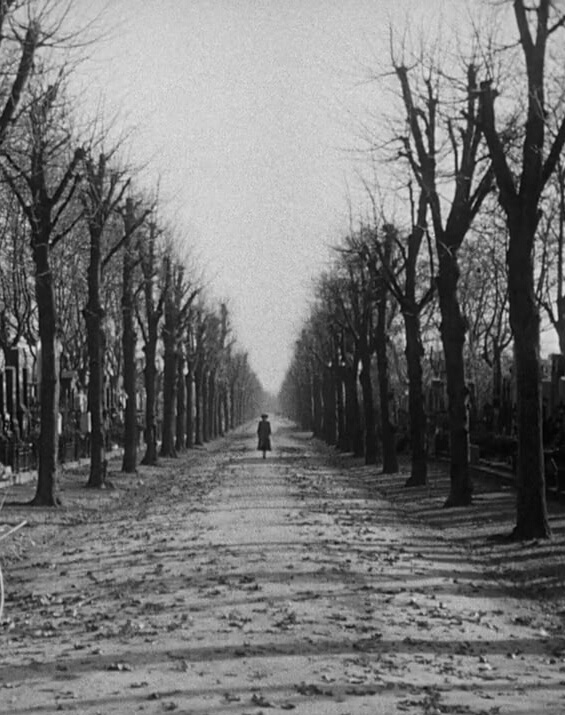
I referenced The Third Man in an earlier post, and make no excuse for once more including a still from the final scene and my comment that accompanied it:
A long, slow walk to the accompaniment of the haunting refrains of Anton Karas’ zither as Anna decides that a happy ending is far too bourgeois for one of the 20th century’s most pivotal films noir …
… or watch here as Anna walks out of Holly’s life:
Postscript: The Third Man completes a trilogy of classic films noir that I’ve seen on the big screen thus year: a special Valentine’s Day screening of Casablanca, Gilda at Aberdeen’s Granite Noir festival and now The Third Man. A good year for the classics!


You must be logged in to post a comment.